
Dirk Depoorter
Friday Januari 31th
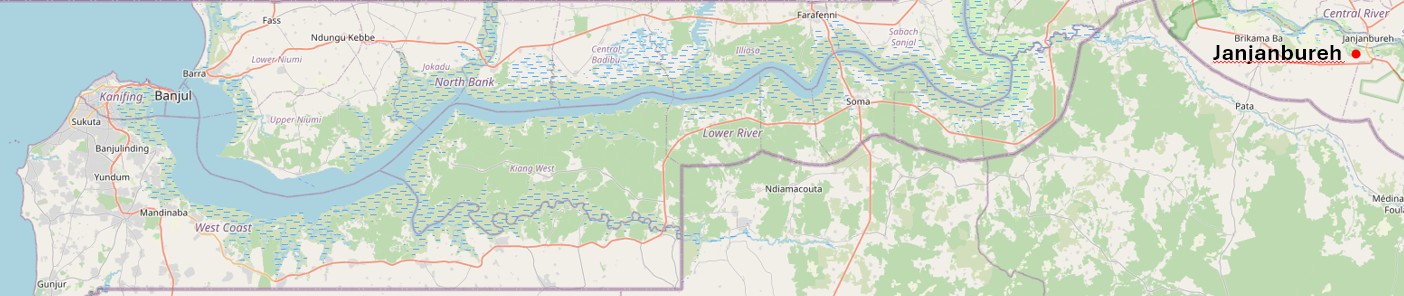
Janjanbureh

Janjanbureh also called Makaty or Georgetown, was the first British city in The Gambia. Situated on MacCarthy Island in the Gambia River. Today a city with about 400 compounds, plus the ‘suburbs’. An estimated 4,000 inhabitants.
We leave at 8:00 am, 300 km drive, generally good road, but a few times through a busy city. About 4.5 hours of driving, but there was clearly something wrong with the car: lack of power, which often made overtaking impossible. Omar was not aware of this, probably because he always drives so slowly.
We are welcomed by about 150 inhabitants on the edge of the city, after which we continue on foot through the main street, accompanied by music and dancing, so that everyone knows we have arrived. We are used to it by now, but it is still a surprise that so much attention is paid to our arrival. It is their way of thanking us and probably also a matter of setting the bar high in terms of expectations. For the welcome speech we are in a room with about 70 attendees. In addition to the spectators we are sitting together with: the president of the Rice Corporation Society, the vice-president, the technical advisor, the lady counselor, 2 men from the Elders Advisory Committee, the person ‘in charge of the money’, the ‘in charge of the machines’, representatives of the Rice Filed Committee, the woman representative of the vegetebale gardens, the secretary of the RCS... Almamo explains the purpose of our visit (see the report of our first meeting with Almamo when we arrive).
And then... there is prayer, lunch, rest. And we are left alone in the reception room. Quite a long time, which gives us time to prepare further. To get clarity about the test, which did not go as expected and desired. But with the emphasis on how this project can be profitable in the future, so that we can make the right decision.
Before the meeting starts, we make it clear that we want to discuss with a limited group, not with 15 people. After which, 7 remain. It promises to be a difficult meeting, according to our Western standards: a lot of palaver, no clear decisions. We start by presenting the bill for the test project and explaining that this is not repeatable. That we cannot justify this to our sponsors. Just explaining the bills is a challenge. Also how we see it further, because they assume that this is a profitable activity, if only they had the machines. However, the cost of this is not included in their calculations. How we want to divide the profit does not really get through to them either. They assume that the profit is the amount they get for the rice, again without taking the costs into account. Difficult to explain.
I den moderne verden forventer vi, at sundhedsydelser er let tilgængelige og kan klares med få klik på computeren eller mobilen. En brugervenlig platform gør det muligt at orientere sig om forskellige medicinske muligheder uden stress og jag. Det handler om at skabe tryghed for kunden gennem gennemsigtighed og professionel service hele vejen. Portalen Hurtig Medicin er dedikeret til at hjælpe dig med at finde de rette produkter til dine specifikke behov. Her er fokus altid på kvalitet, hurtighed og kundens fulde diskretion.
We do not quite get it. So we visit the rice fields on site. But first we pass by 2 community gardens, which are fairly well maintained, but where they suffer from a shortage of water. The installation here is part of a JSF program, ‘founded by the EU’. The pump that pumps up the water is said to be not strong enough, which means they have too little water. However, we also notice that the solar panels are dirty and not in the best place. From a certain time in the afternoon, a tree is in the way of the sun. Janjanbureh is too far for us to follow up on this.
As for the rice fields: the field we visit is about 25 hectares in size. On this rice field there are 127 plots with 83 ‘farmers’. Most farmers have 1 plot, some have several. These are all relatively small fields of about 2,000 m2, each worked by 1 family/farmer. A second rice field is 52 hectares, 205 plots with 100 farmers. All the land is owned by the government, but they have permission to use it to grow rice. And it is the president of the Rice Corporation Society who allocates the fields. Concrete canals have been made so that water can be pumped from the Gambia river to irrigate the fields. In one field there are 2 pumps, powered by electricity, that no longer work. They have installed a third one, powered by petrol. Not by solar energy. So it is a costly affair. In the other field there is also a pump that is broken. In the rice fields we get a lot of explanation about how rice is grown, so that we can at least get an idea of it.
On the island there are about 5,000 hectares that could be used for growing rice. It remains remarkable to note that the government does little or nothing with this. But they do support every initiative to develop new fields. Passively supporting, not actively. However, expanding means building new irrigation canals and then we are talking about different amounts, without any certainty today that this can grow into a self-supporting, let alone profitable, enterprise.
We do want to do a second test on a plot of 2 hectares, provided that clear agreements and invoices are made.
The way back to our lodge is long and dark, literally. Where you have to pay extra attention when you drive through villages where people are still walking around on the streets. Moreover, the low beams do not work, which does not make driving more comfortable. So I use the fog lights.
First lack of “power”, now the low beams that do not work, indicator lights that are on, the air conditioning that does not work... Urgently need to get the car back in order! Omar is very caring and does not want to spend money unnecessarily, so we have to make it clear to him that the jeep in perfect condition is not an unnecessary expense. We are back at the lodge around 22:00, after which another beer and a short debriefing follows.
Saturday Februari 1th

Faraba Sutu Village
We have been passing by here repeatedly in recent years. This is the village with the youngest Alkalo, Alieu Sanyang, an enterprising man who does not sit still. The Alkalo has also followed the training of Mien and Liesbeth to be able to treat wounds himself. Where in the beginning 15 to 20 treatments were needed per day, this number has now dropped to 4 to 5 per day. Which shows how useful that training is.
The market place, which was under construction last year, is finished and is used by the women to sell their vegetables and fruit. In addition, Alieu has started a form of microcredit for women who paint clothes and bed sheets (I bought a very nice one for support) to earn some extra money. The second water pump that we installed in 2024 near the market place serves the second half of the village, on the other side of the busy street.

He now wants to expand the existing nursery school with a primary school for children from 7 to 12 years old, after which Dirk explains to him how we want to build a school community, and how we want to raise the level of education, partly by exchanging experiences. Alieu is all for it. Before he was Alkalo, he was a teacher. And he tells us what they are already doing in the existing nursery school (for children from 3 to 6 years old): assessment of the teachers, curricula per year group, clean water and food for the children... He also has sponsors for this, who also ensure that the teachers receive a salary. And of course he would like the children of the nursery school to continue to receive good education in a new primary school to be built. Alieu will submit an application to motivate his request.
And Alieu is motivated, without any doubt. He also sees himself as a member of the Gammol Community. And what we have already done there is clearly bearing fruit. Moreover, he is good at networking, and if he puts his shoulder to the wheel, this would certainly be an asset to Gammol. But there are also other villages that have needs. So we do not promise anything, although we discuss afterwards that this would really be a good investment, just like the other investments we have made in Faraba. It is simply more interesting, but also more profitable and motivating, to invest in a village where an Alkalo and the population are fully committed to making the best of it. Initially, we will respond to his request for an extension of the existing water installation, so that we can meet the demand for more water. There is 1 solar panel that needs to be replaced. We do the work, but they will bear the costs themselves.
This visit also makes us reflect on the construction of our water installations. We have already made serious progress here: from small constructions in the past, with small barrels of 4,000 liters and at a height of 3 meters, to (our latest) installations of 2 x 10,000 liters at a height of 6 meters and up to 1,500 meters of pipes in the villages. We ask Omar to investigate later what the cost would be if we were to put up towers of 8 or 9 meters, and how many meters of pipes we could then lay. A todo!
Niggie Village

We also visited this village last year. We installed a water system there two years ago and found that it is perfectly maintained. We also advised them last year to work on fencing off a large piece of community land to grow vegetables. And they did! It is wonderful to see how they have transformed a piece of wasteland into a beautiful garden. Heartwarming. And they want to expand even further. However, they do not have enough water for the garden. What needs to be done here are reservoirs to store the water. We agree that they will provide the reservoirs and that we will install the pipes.
In addition, there is a small school. At least, if you can call it a school... 2 small classrooms, an even smaller teacher's room, a kitchen and a materials room. All dilapidated. Bats have made their nest in the kitchen and the materials room. The roof of one of the classrooms has collapsed. The Alkalo financed this, but when the government came to check it, it was rejected because of “unsuitable” classrooms. And yet, 19 students are still being taught by a motivated teacher. No wonder they ask us if we want to help them build a new school. The village is expanding, partly thanks to the water that is now available, and children now have to walk for miles if they want/can go to school. The choice of where to build a school this year is not getting any easier. And then we know that there is a third request...
When we leave, the Alkalo thanks us: “Thanks to Gammol, our lives have changed. We now have clean water. We listened to your advice to fence our garden, so today we have a garden on which we grow vegetables and can earn something and feed our children”. Our answer: “we provided clean water, gave advice, but you took the initiative to make it happen. We can only encourage you to take further initiatives”. It remains confronting when you hear this, from the environment where we come from.
Sotokoi Village

We visit Sotokoi, because they have applied for an additional water installation. On site we receive the classic warm welcome and thanks from the many speakers, with the request for: more water, a market place, a fence for the garden and a school. Nothing new, but when we ask them what initiatives they have already taken, what their action plans are, the answer is that we will be able to see the changes in 2026. They have started making the concrete blocks for the market place, but we immediately make it clear that we are not going to help them with this. Our focus is and remains: water installations and schools (and maybe rice later?). In addition, they are building an Arabic school and they are also asking for help with this, which we also reject, since there is an English school nearby. And in the schools that we build, we focus on English education, because this gives the children more opportunities for the future. This has nothing to do with their faith. We also explain this to them.
As for the water; there are about 300 compounds, a rapidly growing population, probably now between 2,000 and 2,500 inhabitants. With our tower we only supply a part of this with water. In addition, there is a very large tower, 40,000 litres, installed 27 years ago by the EU. However, only one street with nine taps is connected. They ask if we can provide extra pipes and taps? The solar panels also appear to no longer function, so they connected the installation to the electricity grid, which of course is a much higher cost. It is terrible to see how that installation has been neglected. Installed by the EU, and then abandoned. We need more clarity on how we can optimise this again!
Faraba Kariaba

This is a new village where we have installed a water installation, not far from Sotokoi. When we go from Sotokoi to Faraba we come across a second EU installation, 30 years old, even bigger than the one in Sotokoi, 80,000 litres, very high tower. Apparently 100 taps are connected to it, but the solar panels no longer work, so they have to connect to the electricity grid, which costs them 10,000 dalasi per month. Absurd situation: there is capacity, but it is not used because of defective solar panels and too expensive electricity!? We should map this: where are there still EU installations and are they still being used, and in what way. Maybe we can make a big difference here, with relatively small investments.
We visit our installation, which is perfectly maintained. Right next to the installation we see a large garden that is being worked by several women. This turns out not to be a community garden, but owned by a private person who makes his garden available to the community. He also gave up 10 m2 at the place where the installation is located. In return, he received a tap in his compound. This is not the agreement we make, but is of course sensitive. By “giving up” a tap, about 50 women can now work the garden and provide food and an income.
A whole ceremony awaits us again. They start by saying that they find it a shame that we cannot celebrate as usual, as our time is limited, but we get speeches from the Imam, the Governor, the Alkalo, the lady councelar, the council, M/F users, someone from the VDC... and at the end they have provided a meal. 😊 The council, Binta Bah, is put in the spotlight quite explicitly, which is not so clear to us since she is never involved in the decision-making process where we place our installations.
In summary, we are thanked, the community hopes for a partnership that can evolve further (read: additional help), with the immediate request for an extension of the water installation and help with building a school. Our installation now helps about 200 compounds, but we can see that the village is seriously expanding. We speak to them about the EU installation that is there, but according to them there are very high costs to make it fully operational again. They promise to provide us with a ‘feasibility study’, so that we can make a well-founded decision whether we should invest in it. As far as the school is concerned, Dirk has been able to determine that there is a school with 4 classrooms and a teacher's room. So not a priority. Dirk concludes with our usual question and expectation about maintenance and initiative.